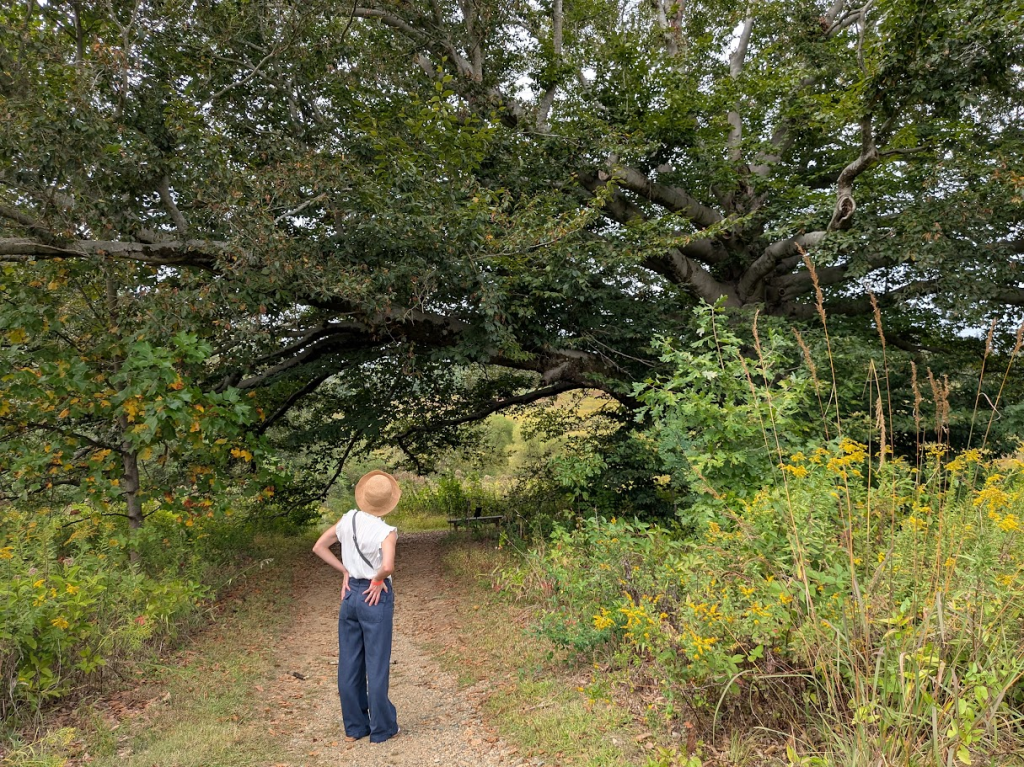
Me, looking up at a grand American beech tree, Fagus grandifolia, located on an edge within Longwood Garden’s Meadow. Fall 2025 and our first time encountering it.
I have to add a disclaimer to this post saying that I am not an arborist, botanist, or formally educated in trees in any way. I am simply a tree enthusiast, someone who loves trees and enjoys learning arboriculture. I like to learn about proper tree care and maintenance, identification, and the diseases and challenges faced by native North American trees. My knowledge is still limited and imperfect, but the information I present in my posts is accurate to the best of my knowledge.
You’ll be sad to know that many native North American trees are facing great pressure from various diseases and pathogens. Do you take the time to look at the trees in your neighborhood or local forests, and seen the numbers that stand dead and bare?
The mountain pine beetle; southern pine beetle; Dutch elm disease; emerald ash borer; butternut canker; oak wilt; sudden oak death; chestnut blight; beech bark disease; hemlock woolly adelgid. . . and so many more.
But this post is about a new emerging threat; one that, at the time of writing this, has no cure and is almost certainly fatal: Beech Leaf Disease.
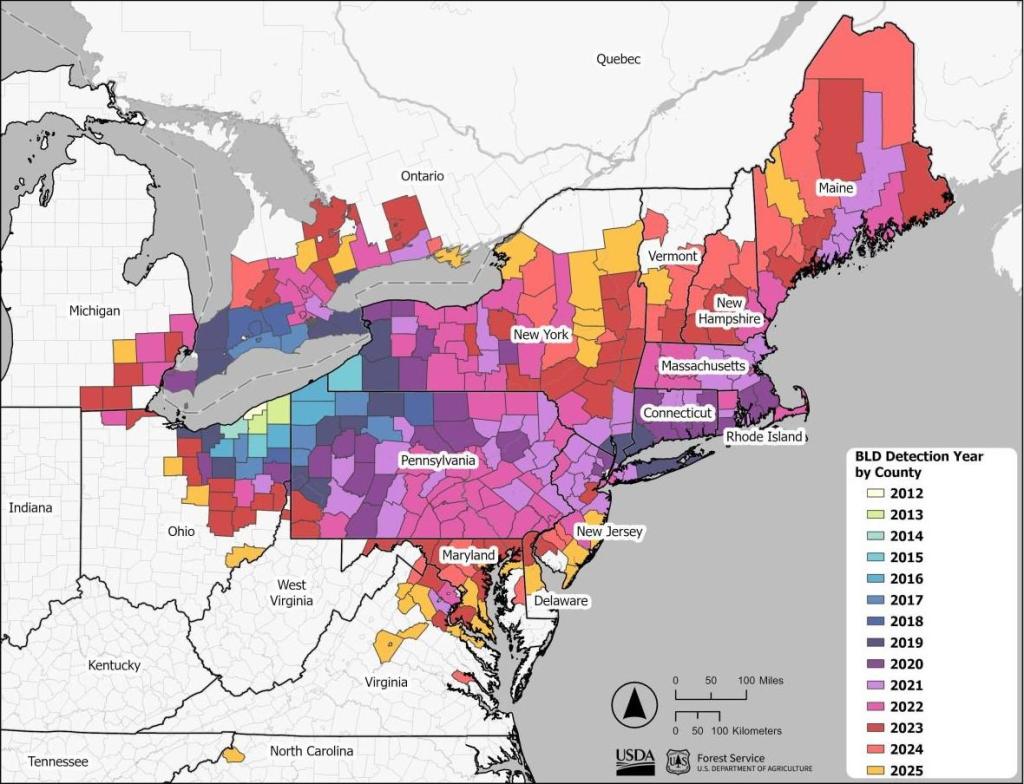
First observed in Ohio in 2012, beech leaf disease (BLD) has spread to the southeastern corner of Michigan and into Ontario, Canada, down to North Carolina, and up through the entire East Coast of the U.S, according to data generated by the USDA Forest Service.
BLD is caused by “infestations from Litylenchus crenatae ssp. mccannii, a plant‐parasitic nematode” (McIntire et al., 2026), and visually presents as dark striping between the leaf veins and distorted leaves, followed by crown decline and dieback.
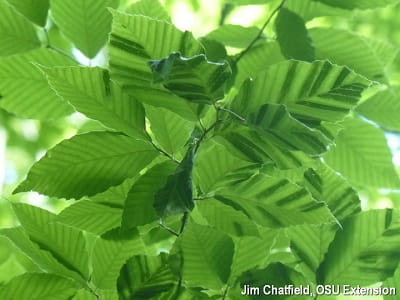
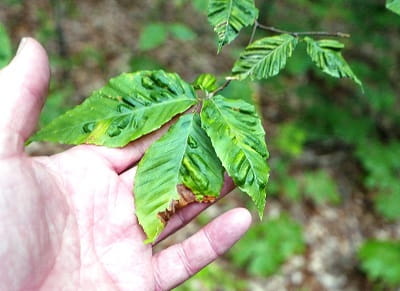
^ Courtesy of Michigan State, Michigan Invasive Species
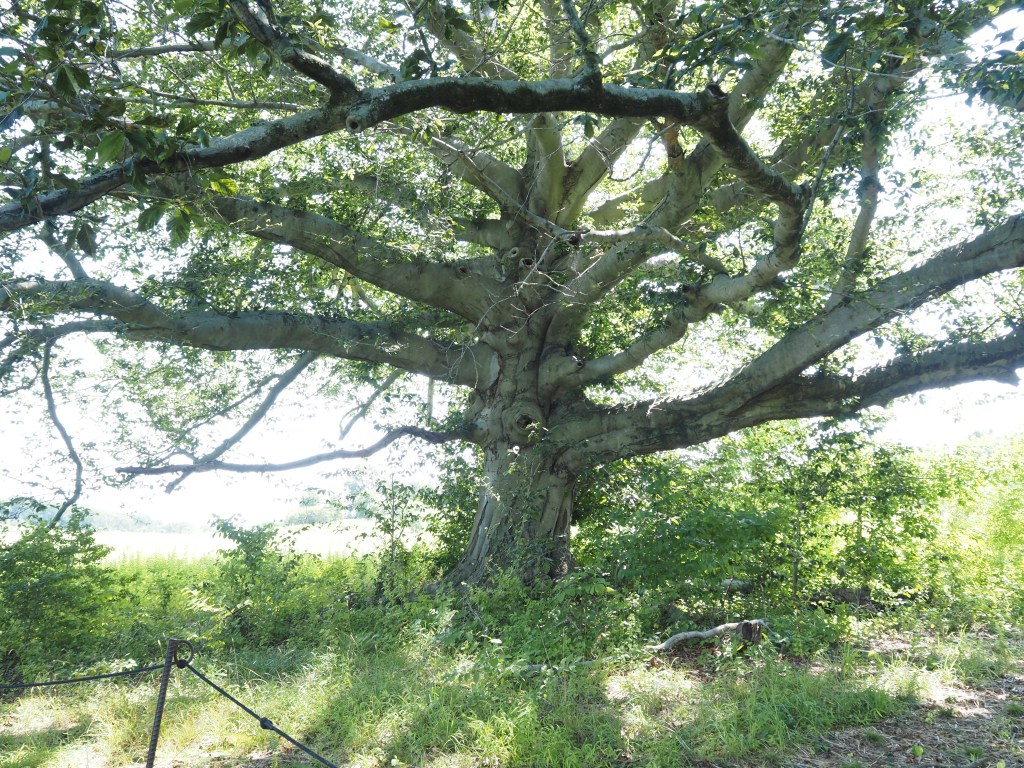
The Mighty Beech tree, July 2026:
Photos of its leaves taken at the same time:
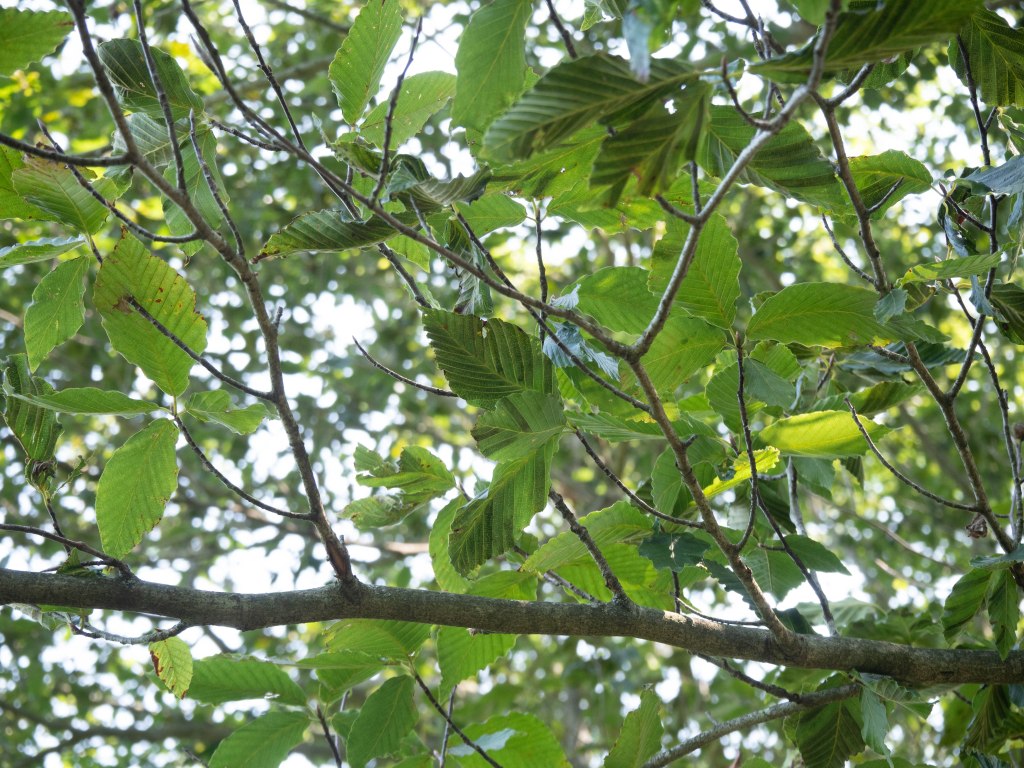
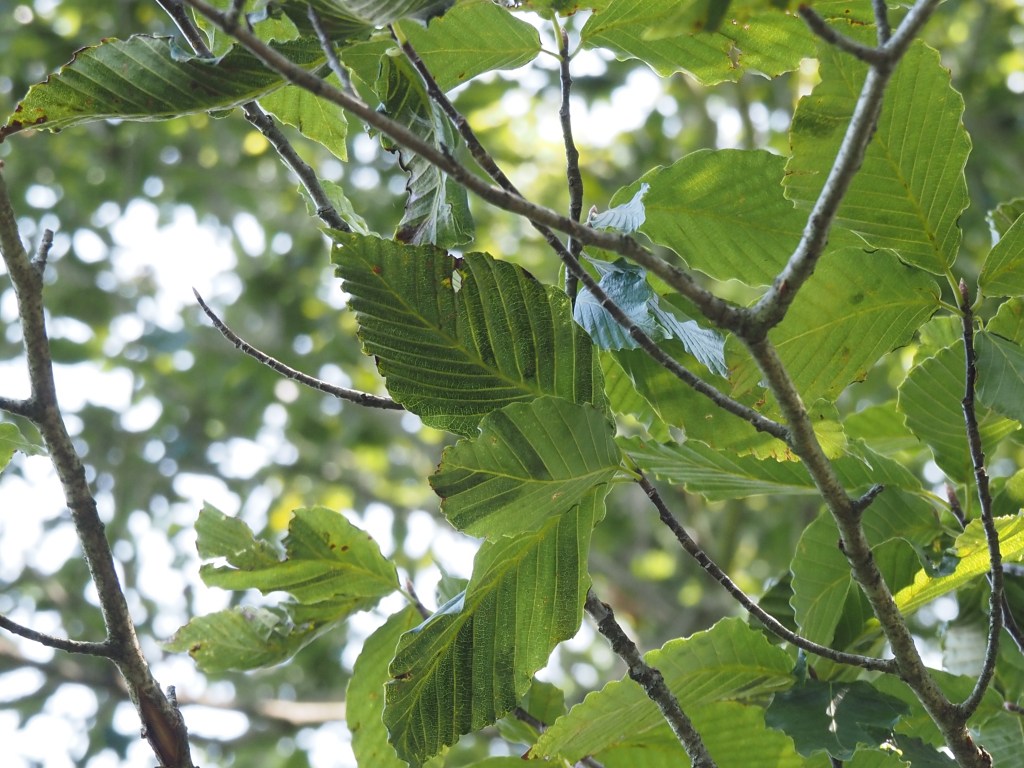
Again, I’m not an arborist, but I believe the symptoms are unmistakable. Additionally, the “Beech Grove” at Longwood Gardens has already had several diseased trees removed and a sign has been placed explaining its presence in the area, and that Longwood is monitoring the situation. Southeastern Pennsylvania has been hit hard by BLD, but I’m glad that Longwood seems to be giving this beech tree more time, presumably in hopes of a recovery.
Although the exact mechanism of tree death is not yet fully understood, there has been research into how the nematodes impair healthy physiological function and theories have evolved. The parasitic nematodes first infect dormant buds and these infected buds either fail to open, or open distorted in the spring with the adult nematodes and their eggs present in the leaves (Carta et al., 2020).
Research by McIntire (2023) shows that leaves with BLD symptoms have a reduced capability to photosynthesize effectively, and further research done by McIntire et al. (2026) indicates this negatively effects the tree’s ability to produce and store enough energy (carbohydrates) to sustain normal growth and function. The tree will even attempt to push out new leaves during a growing season, further expending what energy it has. Put very simply, an infected tree can’t capture enough carbon from the atmosphere to feed itself, thus leading to canopy loss and branch dieback and, often, death.
Let’s look at the Mighty Beech again.
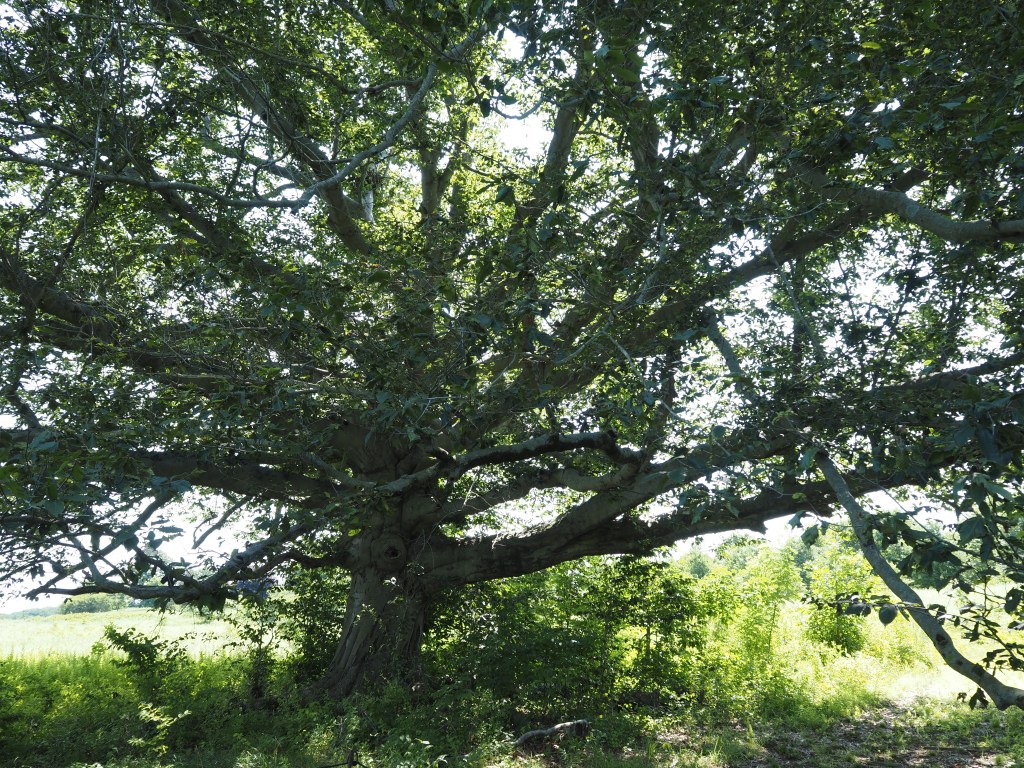
There is some hope in new treatments for beech leaf disease; some of these include the systemic fungicide thiabendazole as a root flare injection, and the fungicide and nematicide fluopyram applied as a foliar spray (Loyd et al., 2025; Loyd et al., 2024). These studies performed by Loyd et al. demonstrated visual improvement and reduced numbers of Litylenchus crenatae ssp. mccannii within the studied trees’ leaves.
There is still uncertainty in the efficacy fluopyram has in killing the nematode eggs, however, and foliar sprays present environmental concerns. There are also questions on the usefulness of its application when the treated beech remains surrounded by other infected trees (Schleker et. al., 2022). Additionally, root flare injections, like that of thiabendazole, are expensive and require reapplication, making them unrealistic for private landowners or use on large stands of trees.
I hope that this American beech, and many others across the U.S., can survive this disease, whether through their own resiliency or with human intervention. Millions of other great native North American trees have already died because of introduced pathogens, and the beech tree has already suffered from beech bark disease.
Looking back at my photos of this mighty beech tree from last year, I can actually see signs of BLD already present in its leaves. It has survived this long, and perhaps it may for many more seasons. But what is “soon” for a tree that can live for 400 years? The passage of time is not the same for trees as it is for humans, and whether it takes two years, five, or 10, its life will surely have been cut short. This makes me sad, and I can only be glad that I have had the opportunity to give it my adoration and respect.
References:
Carta, L.K., Handoo, Z. A., Li, S., Kantor, M., Bauchan, G., McCann, D., Gabriel, C.K., Yu, Q., Reed, S., Koch, J., Martin, D., & Burke, D. J. (2020). Beech leaf disease symptoms caused by newly recognized nematode subspecies Litylenchus crenatae mccannii (Anguinata) described from Fagus grandifolia in North America. Forest Pathology, 50(2), e12580. https://doi.org/10.1111/efp.12580
Loyd, A. L., Borden, M. A., Littlejohn, C. A. Rigsby, C. M., Brantley, B., Ware, M., McCurry, C. & Fite, K. (2025). Thiabendazole as a therapeutic root flare injection for beech leaf disease management. Arboriculture & Urban Forestry (AUF), 52(4). https://doi.org/10.48044/jauf.2025.007
Loyd, A. L, Cowles, R. S., Borden, M. A., & Lamondia, J. (2024). Exploring novel management methods for beech leaf disease, an emerging threat to forests and landscapes. Journal of Environmental Horticulture, 42(1), 1-13. https://doi.org/10.24266/0738-2898-42.1.1
McIntire, C. D. (2023). Physiological impacts of beech leaf disease across a gradient of symptom severity among understory American beech. Frontiers in Forests and Global Change, 6. https://doi.org/10.3389/ffgc.2023.1146742
McIntire, C. D., Loyd, A.L., Rigsby, C.M., Lemis, P., Karlsen-Ayala, E., Littlejohn, C., Bergdahl, A., & Garnas, J.R. (2026). Beech leaf disease impairs growth and carbohydrate storage in Fagus grandifolia. Forest Pathology, 56(2), e70068. https://doi.org/10.1111/efp.70068
Schleker, A. S. S., Rist, M., Matera, C., Damijonaitis, A., Collienne, U., Matsuoka, K., Habash, S. S., Twelker, K., Gutbrod, O., Saalwächter, C., Windau, M., Matthiesen, S., Stefanovska, T., Scharwey, M., Marx, M. T., Geibel, S., & Grundler, F. M. W. (2022). Mode of action of fluopyram in plant-parasitic nematodes. Scientific Reports, 12(11954). https://doi.org/10.1038/s41598-022-15782-7


Leave a comment